


The first half of the film follows Binoche and a British author named James who has just written a “philosophical” book about “the nature of the copy” (the authors book is the title of the film), while the second centers around the two pretending to be a bickering married couple and getting carried away in the roles.

For my money it’s the first half that’s most rewarding, full of juicy of intellectually sparing and flirting, in solid measures from both leads.

The second half and its “Whose Afraid of Virginia Woolf?” tangents though cute and amusing enough at first, become somewhat inscrutable by the end.

I know its “Juliet Binoche" and all that implies, but what man, what person, would willingly sit through the sexist emotional horse whipping she dishes out on a first date, on a first encounter? Who needs that kind of abuse from a stranger, even an attractive stranger?

Her later arguments amount roughly to standard sitcom and lazy stand-up routine banter of “all you men are insensitive, disloyal, and irresponsible.”

In fairness we do get the impression that she is projecting her experiences of the past (her son's noticeably absent and unmentioned father) and apprehensions of the future and uncertainty about giving her heart away to someone new, especially someone she desires as obviously as she does James, who remains annoyingly aloof and comfortably distant when it comes to specific personal matters.

Her son chastises her early on in the film for lying and telling half-truths “I saw you. You want to fall in with him”. James not far after remarks that when children tell the truth we scold them, but when authors and philosophers say the same thing, we treat it as it were profound. This is probably the best insight Kiarostami has into the nature of the “copy”.

The value of an object is not found in any qualities it inherently possesses but in our perception and coloring of those qualities themselves. "My sister's husband has a stutter, but she loves him so much it's like music to her." relates Binoche. She is attracted to James before she ever meets him, from only reading his book (for reasons I won’t get into here, but which also lead back to inspiration and copies).

There meeting is more like an interview where Binoche can ascertain if her fantasy has any basis in reality. Can he play her games? Can he understand the truth contained within her games and pretenses? Is he something new and “authentic” or an imperfect copy of former lovers?

James is stuffy and a bit egotistical, but also charming and witty, while Binoche is passionate, intimate, eccentric, flighty and mysterious.

In other words he is British and she is French, wonderful performances aside (both leads do a great job), the characters are somewhat stereotypical projections of European cinematic identities.

The “philosophical” ramifications of the copy in modern(post-modern/whatever) life are so myriad, it would take several films to faithfully explore; sampling in music, collage in visual arts, the evolution of digital code and the Internet, the plating of crops outside of their natural habitat in ecology, etc.

“We are all imperfect copies of our parents”, James remarks at one point. Looking back Binoche’s son is just as impertinent as she is, so the idea holds its share of water, but otherwise many of James ideas about copies are vague, general, or obvious and Binoche can see this, trying to prod, invade, and violate his authorial distance with any trick she can, stumbling into the bickering couple persona's by accident, after an old woman mistakes them for a couple.

I can understand how skipping the typical 20 questions and getting directly into the “what will be arguing about in the future” part of the relationship might have its appeal, even on a first meeting/date, but I have trouble believing it as I watch it.

Their arguments and discussions in the film ultimately amount to little more flirting. Both Binoche and James know what they want from each other the moment they meet, the next hour and a half is just an roundabout discussion of terms and airing of oblique grievances.

This may sound bleak to some, but both characters by the end of the film seem to realize that “authenticity” or expecting perfected sui generis objects, properties, or people is useless, especially if there are perfectly good copies of these things around for us to experience.

David Mamet’s awful “Redbelt” is this film's polar opposite revolving around draconian notions of “intellectual property” dressed in a macho (and culturally inaccurate) depiction of martial arts.

By thematic comparison “Certified Copy” is easily superior, but compared to similar talky films like those “My Dinner With Andre”, “Mindwalk”, “My Night At Maude’s” and especially “Before Sunrise/Sunset”, the competition gets more rigid.

On matters of the mind those first three films are equal or better, and when it comes to replicating the spontaneous free flowing dialog between couples walking, talking, and becoming more deeply immersed in each others psyches, “Before Sunrise/Sunset” are stronger films.

The cinematography and editing of “Certified Copy” include some of Kariastami’s tightest frames to date. The lingering landscapes and still scenes famous in his earlier works have been minimized in favor of more direct and accessible style.

Indeed “Certified Copy” is a cross-over film, leaving behind the perceived “exoticism” and self conscious experimentation of cinephilia, in favor of the accommodating familiarity of moviedom and perhaps nods from establishment and Academy; from minority to mass market.

I don’t mean to suggest this film is only a career maneuver (as if Kiarostami would suddenly become an A-list Hollywood darling from this overnight), it is an interesting account of attraction, authenticity, inspiration, and sincerity, that makes short work of platitudes like “honesty is always the best policy”, showing how pretence and persona are just as equally enmeshed in the fabric of human contact and relationships.

“The copy by leading us to the original, certifies itself” says James early on at a lecture, so regardless of whether this is a great work, or Kiarostami’s best or his least, his most sell-out or his most heart-felt, it exists as a lure, into all the other artworks it makes mention of, to Kariastami’s own ovuer, and if you’ve gotten this far, to even films I prefer like “Before Sunrise/Sunset”. For Kiarostami in this film, art and artfullness is not the ultimate aim, documenting and observing human connections is.

His film before this “Shirin”(also briefly featuring Binoche), was an arduous (to put it mildly) experiment, made up of close-ups of women’s faces while they watch a film. At once it is completely a gimmick and experiment, but at the same time it documents a very real feeling and cinematic sensation. When showing a film to someone we hope will enjoy it, our attention is half on the film and half on the reactions of the people we show it to.

Do they smile when I would have? Do they express sorrow at the same moments I found so moving? One of Binoche-esque French-pixie Audrey Tautou’s pet pleasures in "Amelie" is looking over her shoulder at the reactions of others in movie theaters. Likewise “Certified Copy” looks down a narrow alley in human expression, and finds two people nervously trying not to look at each other too deeply out of fear they might disappear into each other completely forever.

We are all copies looking to be certified.


 "Uncle Boonme" is the final part of a multi-platform project featuring art installations and short films called "The Primitive Installation", about Nabua, Thailand a region heavily occupied by the Thai army from the 60's to the 80's.
  "Uncle Boonme" believes his karma is the result of the part he played in the violence of the past.
 Director Apichatpong Weerasethakul ("Joe" for short) has created a landscape of shadowy jungles, intimate bedroom lighting, a haunting, funny, dreamy, and wise, rhythmic lamentation about modern life, it's "primitive" counter points, death, change, spirit-monkeys and all that good stuff.
  Uncle Boonme is a fantasy as epic as Souleymane Cisse's "Yeelen",
  Transformations and contrasts between the ancient and the modern flow into one another from electronic bug zappers to sex with talking cat-fish, primordial caves to karaoke bars.
 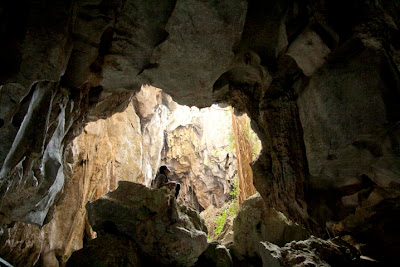 Dual and multiple-roles and states within a single whole, are a recurring theme in the film, so multiple meanings and readings being generated is little surprise. But though these thoughts rise up haunting us after viewing, the images of movement through Nabua's
  All modern worlds are built on ancient ones, all new things have within them older forms. "Uncle Boonme" is more informed by Buddhist notions of reincarnation, the idiosyncratic personality of it's creator and the psycho-geography of it's location, more than normal concerns about dramatic and character arc.
  In simpler words...an old man who is dying can recall his past lives. The film is a matter of perception as complex and post-modernist/globalized as any experimental narrative in avant-garde-dom or as mystical and "primitive" as any ancient Sutra, based on the cultural inclinations and presuppositions you bring to the film.
  In any event, is to Joe's continued success and cinemas continued fortune that he so playfully and beautifully can challenge and delight these hybrid perceptions of ours as he does.


