
Sånger från andra våningen (Songs From The Second Floor)(2000)
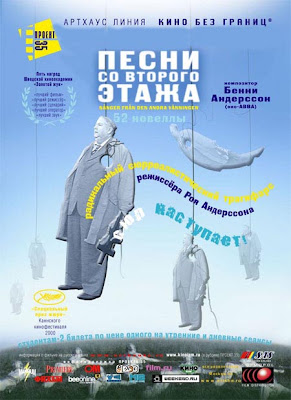
Directed By Roy Andersson
 Songs From The Second Floor, is the second feature from director Roy Andersson, whose spent his career making according to fellow Swedish director and film legend Ingmar Bergman, "The best commercials in the world".
  This film the first in a stylistic trilogy beginning here, going onto "You The Living", and to conclude with what director Andersson says "a third enormous, deep and fantastic, humorous and tragic, philosophical, Dostoyevsky film."
 Anderson takes an advertisers eye to this film and inverts it, into around 40 or 50 short vignettes, some with recurring characters, like the man seen on the cover who has burned down his business to collect the insurance but bumbled the job, while most include walk-ons, and many characters drift in an out of scenes before the movie ends.
 These short vignettes are nearly all deadpan and absurdist tragi-comic advertisements for peoples lives broken or on the verge of breaking.
 The antagonist, if there must be one, is capitalism (a subject which the commercial making Anderson is very much aware), and it's de-humanizing effects on all its touch.
 As melancholy and bitter as all this sounds, the material is played more often than not for laughs.
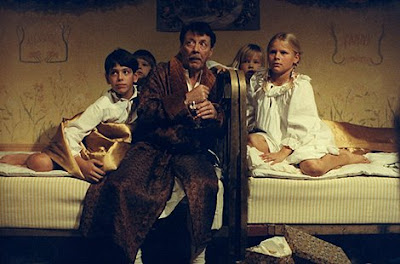
 There's a scenes where a traffic jam has clogged the city, as if everyone were leaving at the same time, a girl is blindfolded and lead of a cliff by her village elders, her entire town, and gathered officials, a man accidentally sawed in half by a feeble magician, men and women in business attire walking down streets in parade's flailing themselves as an act of penance to God so he will prevent the further falling of stocks (an allusion to Bergman's The Seventh Seal, where flailing was done to ward off the black plague), and our hero a failed salesman who made a poor investment in large crucifixes, who suddenly is aware of, having conversations with and being followed around by the ghosts of friends and strangers from throughout time (we even see a vignette which tells the story of the one of the ghosts deaths).
 [throwing away Christ crucifixes he couldn't sell] "Business Man: I am so embarrassed, my face is red. I staked everything on a loser."
  If that weren't to dazzle your attention, each scene is composed with a static non-moving camera, giving every moment the detailed composition of a photograph or painting.
 The movie is an requiem for a homonogized (drained of color and life, like each set and character) culture and the global snare of first world capitalism (the gridlock the permeats the background, seen through windows or just down the street).
 It's characters are living just before the new millennium, and are entering plauged by ghosts, worshiping corporate gods, and damned to etnernal traffic gridlock.
  The film's unobtrusive stand off aesthetic and brief narrative structure prevents the audience, from any long term identification and investment in any particular characters, though our portly business man who sees dead people clearly gets the most screen time.
  The punch-line wit and unpredictable nature of each individual scenario is what slowly snowballs into the film head long into a savagely clever and unique black comedy avalanche. It's a slow crawl getting there, like the Night Of The Living Dead throwback, as the ghosts slowly close in our hero, yet scatter like squirels as he throws rocks at them.
  It's like a lyrical Monty Python film, or a bleak, bleached, Wes Anderson, and yet again it's a film all it's own, structurally, conceptually, and aesthetically, if your interested in where film-making may be going in the future and right now, Songs From The Second floor, is the movie to see, and one of the best of the new millennium.
 Kalle: "He wrote poetry till he went nuts!"


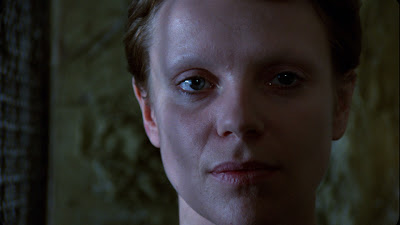



 Directed by Tomas Alfredson(2008)
 It's easy to like a film this laid back and comfortable with it's character driven very cute, but not sentimental, vampire story about 12 year olds.
 The plot is pretty self explanatroy, new girl moves in(at night), and shy boy next door slowly be freinds her. We, the audience, of course know what's going on long before all of the characters do, and it comes as minor revelation; what's a little vampirism in the face of young wuv.
  I'm not sure though, that this movie is all sweetness, as Eli (the girl next door), we know is not a 12 year old, and as this sinks further in, and you look at her relationship with her "Father/Henchmen/Renfield" in the movie, Oskar and Eli's relationship seems much more unhealthy/uncertain.
 The special effects were used at a minimum, which gave the moments when it was in full effect, their weight and gravitas. Except for the scene with the cats, which was a hilarous misfire (or intentionally comic), either way it was funny.
  "Let The Right One In" is as much a cautionary tale of vampires, as it is of relationships, and who we allow into our lives, (The vampires in this film can't enter your home until invited).
  Some will find it too slow. I thought it was charming and pretty, which is unusual for a vamp flick, especially now-a-days.
 The pool scene is great. The audience applauded.
  A good start for the Six Shooter film series (a project designed to give the best 6 genre films from around the world, Stateside distribution.)


