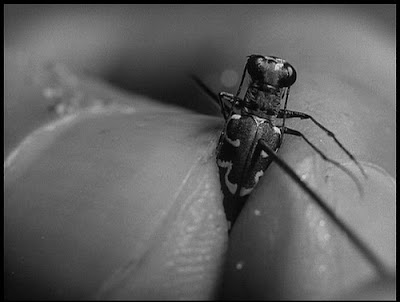
Otoshiana(Pitfall)(1962)  Directed By Hiroshi Teshigahara
Directed By Hiroshi Teshigahara
 Dopplegangers, ghosts, mines, demons in white, union in-fighting, political dismay, and wonder full black and white photography of murders along a river bank.
 Hiroshi Teshigahara and author Kobe Abe made four films together "Pitfall", "A Woman In The Dunes", "The Face Of Another", and "The Ruined Map".
 So far Ive seen the first three, which are all black and white, and they are all top marks, for conceptual brilliance, visual beauty, talented performances, and devastating emotional flair.
 Teshigahara/Abe, in this period were the Japanese avant garde's Powell/Pressburger.
 A man leaves a mine, in hopes of finding work somewhere with a union.
 He finds another mine, but is killed when he arrives by a mysterious man in white.
 He bears a striking resemblance to a current leader of one of the unions, and this only fans the flames of hatred between the "big mine" union, and the "little mine" union.
 The man killed at the beginning lingers on in the film, as a ghost trying to solve the case of his murder, which another ghost warns him, "won't make him fell any better."
 It veers so freely and naturally between, the life and after-life of labourers, that the two become indistinguishable.
 The comic, horrific, philosophic, and photo-realistic elements that might seem an unnatural blend, but they come together here as if they could fit no other way.
  "Pitfall" is my least favorite Teshigahara film, and it's also his first, but for fans of Japanese cinema and those interested in good movies in general, the black and white Abe trilogy is a must see, on par with Kurasawa, Antonini, and Imamura.
 See one, see em all.