
Un Lac(2008)  Directed By Philippe Grandrieux
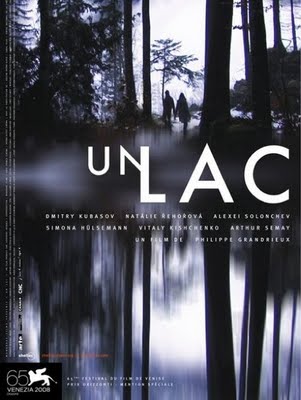 Directed By Philippe Grandrieux
 Un Lac is a tone poem of a film, told mostly in close-ups.
  When not getting all up in everyone's and everything's face, the camera gazes around aimlessly at fog, mountains, snow covered woods, light from the sun or moon piercing through fog, as if to alleviate the smothering, over-proximity of sheer human contact, the camera has to fuck off to the woods shake from it's head the discombobulated images of skin, hands, shoulders, and shadows.
  When characters are large enough to be identified as characters (and not tall shrubs) they are often at too far a distance to be individually discernable, such is "Un Lac's" prerogative, always too far or too close.
 If Philippe Grandrieux had a sense of humor he would make a horror film about Bigfoot, and capitalize on Mitch Hedburg's idea of the big out of focus monster roaming the woods, but sadly Mitch is dead, and Philippe is all business.
From the first few minutes forward it's apparent that the film will be opaque and ambilavant and ambigious, and like the best of ambient music and the worst of Muzak, it will at times be very boring, formless, and repetitive, but will also at times be beautiful, startling, and rhythmic.  How much you like this film will really amount not to Grandrieux's talents (which are not without merit), but your appreciation for this style of art.
 If you have a great sense of patience and sensitivity for minimalism, than Grandrieux's shaky cameras and general blurry fuzziness, work together to create a cinematic white noise drifting over a skeletal framework of tension and actions. If not it's going to be annoying.
 "Un Lac" is not quite completely abstract non-narrative experimental film making, but it's a vicious flirt with being one, and teases our hopes up numerous times that it will eventually unmoore itself and let Grandrieux's visual style finally run naked and free.
  Alas, he remains shackled to a plot consisting of some really cheesy and rather typical French movie incest bullshit at a rural lake house/logging cabin, between a doe eyed sister and her dark eye socketed (we get it your supposed to be creepy) brother.
  At least until some hot guy shows up to work the timbre (no pun intended) and then the brother get's jealous, and the girl falls for the guy, and the reason I didn't fall asleep altogether before the end was because of the overdetermined suspense (from my previous experience with Sombre), that the brother was going to murder his rival with an axe on some Dostoevsky shit.
 This sadly never happened.
 How much you like this film will really amount not to Grandrieux's talents (which are not without merit), but your appreciation for this style of art.
 If you have a great sense of patience and sensitivity for minimalism, than Grandrieux's shaky cameras and general blurry fuzziness, work together to create a cinematic white noise drifting over a skeletal framework of tension and actions. If not it's going to be annoying.
 "Un Lac" is not quite completely abstract non-narrative experimental film making, but it's a vicious flirt with being one, and teases our hopes up numerous times that it will eventually unmoore itself and let Grandrieux's visual style finally run naked and free.
  Alas, he remains shackled to a plot consisting of some really cheesy and rather typical French movie incest bullshit at a rural lake house/logging cabin, between a doe eyed sister and her dark eye socketed (we get it your supposed to be creepy) brother.
  At least until some hot guy shows up to work the timbre (no pun intended) and then the brother get's jealous, and the girl falls for the guy, and the reason I didn't fall asleep altogether before the end was because of the overdetermined suspense (from my previous experience with Sombre), that the brother was going to murder his rival with an axe on some Dostoevsky shit.
 This sadly never happened.
At times watching the faces and shapes emerge from Grandrieux's primordial darkness of dimly lit shots has a rugged elegance. Instead of vibrating with terror, fear, or as much disconcerting menace as it did in "Sombre" the camera has now learned to tremble.
 It may be trembling because it's filming on a snow covered lake and it's dark and it's cold, or it may be because he or she (you know the one) is looking at you from a distance.
  We almost never get a full frame so determining what exactly is happening in any given scene is a chore, one occasionally rewarding, but mostly tedious. Totality is anathema in Grandrieux-land, so seeking closure or completeness visual or otherwise is a fools errand here.
  At one point early on (though the place in the film's chronology are debatable since it's all pretty non-linear) a character has a seizure, and lays twitching in the snow. I believe this causes other characters to later search for him in the woods when he doesn't return home.
  Both yield material for interesting visual scenes (ultra-earthquake shakiness in the former and flashlights in the darkness later) but are irrelevant to the love-triangle that's going off and on in the films center, flickering like a dull lightbulb.
  The entire film is like this, which is not the worst thing in the world if your an imaginative person, attuned to the Zen pacing.
  One should remember "The Simpsons", and Homer's once initial failed cult initiation, and response to the question, "What? None of what you mentioned was in the film. Did you even watch it?", "Oh yeah, well when I get bored I make up my own movie.", because it's precisely what everyone does who comes to a piece of minimalism like this.
  The film is in perpetual limbo, and it's the viewer who will trek through it to find their own heaven or hell.
  Though where Tsai Min Liang's glacial minimalism in "What Time Is It There?" developed and played with our ennui, emotions, and assumptions in ways which were ultimately both edifying and tragic, Grandrieux is sadly satisfied with willful obscurance.
  For it's niche it's an interesting mood piece, but it's so ephemeral that unless you can as Homer did, project yourself another imaginary film or mental space on top of this one, there isn't really enough material here to make this movie any more than what doesn't meet the eye.
  Squint and look out of the corner of one of your eyes, and you have a pretty clear idea of "Un Lac's" style. This is also the type of image the film is most likely to linger on; a close up of an eye either darting around like mad or phlegmatically staring at it's own lashes.
  Is the nearness of the camera to all it's objects, a representation for the characters isolation from the world outside of their family, outside of the lake, intentionally trying to make their limited perspective into ours?
 If so one would expect the final scene of the sister for the first time, on the lake and not the shore, to be fuller, wider, more...well anything.
  Instead her flight does not change anything, (and this may just be me projecting) but I remember almost a look of disappointment or confusion on her face in that scene, that their wouldn't suddenly be more once she got onto the lake. I scowled in sympathy.
 I understood why she should be confused, there is never any true "escape" from our troubles, the world does not expand when we go to a new place, the narrow camera of our eyes is just turned to a new set of familiar objects, to covet, attain, and regret, and even that all depends on how well we can tell the parts from the whole.
  As you can see I have projected a good deal into and onto this, so I can't completely dismiss the movie and it's brand of experiential cinema.
  It is not wrong to want more from minimalism, when it's nature is to create this desire for form and awareness of absence. However it is wrong to not care at the end of a film. And at the end of "Un Lac" I didn't care about what I had seen. So if you think you will like it, you probably will, and if you are suspicious go with your gut. Squint and look out of the corner of your eye again.
 Instead of vibrating with terror, fear, or as much disconcerting menace as it did in "Sombre" the camera has now learned to tremble.
 It may be trembling because it's filming on a snow covered lake and it's dark and it's cold, or it may be because he or she (you know the one) is looking at you from a distance.
  We almost never get a full frame so determining what exactly is happening in any given scene is a chore, one occasionally rewarding, but mostly tedious. Totality is anathema in Grandrieux-land, so seeking closure or completeness visual or otherwise is a fools errand here.
  At one point early on (though the place in the film's chronology are debatable since it's all pretty non-linear) a character has a seizure, and lays twitching in the snow. I believe this causes other characters to later search for him in the woods when he doesn't return home.
  Both yield material for interesting visual scenes (ultra-earthquake shakiness in the former and flashlights in the darkness later) but are irrelevant to the love-triangle that's going off and on in the films center, flickering like a dull lightbulb.
  The entire film is like this, which is not the worst thing in the world if your an imaginative person, attuned to the Zen pacing.
  One should remember "The Simpsons", and Homer's once initial failed cult initiation, and response to the question, "What? None of what you mentioned was in the film. Did you even watch it?", "Oh yeah, well when I get bored I make up my own movie.", because it's precisely what everyone does who comes to a piece of minimalism like this.
  The film is in perpetual limbo, and it's the viewer who will trek through it to find their own heaven or hell.
  Though where Tsai Min Liang's glacial minimalism in "What Time Is It There?" developed and played with our ennui, emotions, and assumptions in ways which were ultimately both edifying and tragic, Grandrieux is sadly satisfied with willful obscurance.
  For it's niche it's an interesting mood piece, but it's so ephemeral that unless you can as Homer did, project yourself another imaginary film or mental space on top of this one, there isn't really enough material here to make this movie any more than what doesn't meet the eye.
  Squint and look out of the corner of one of your eyes, and you have a pretty clear idea of "Un Lac's" style. This is also the type of image the film is most likely to linger on; a close up of an eye either darting around like mad or phlegmatically staring at it's own lashes.
  Is the nearness of the camera to all it's objects, a representation for the characters isolation from the world outside of their family, outside of the lake, intentionally trying to make their limited perspective into ours?
 If so one would expect the final scene of the sister for the first time, on the lake and not the shore, to be fuller, wider, more...well anything.
  Instead her flight does not change anything, (and this may just be me projecting) but I remember almost a look of disappointment or confusion on her face in that scene, that their wouldn't suddenly be more once she got onto the lake. I scowled in sympathy.
 I understood why she should be confused, there is never any true "escape" from our troubles, the world does not expand when we go to a new place, the narrow camera of our eyes is just turned to a new set of familiar objects, to covet, attain, and regret, and even that all depends on how well we can tell the parts from the whole.
  As you can see I have projected a good deal into and onto this, so I can't completely dismiss the movie and it's brand of experiential cinema.


 Directed By Jia Zhang Ke
 Zhang Ke Jai has(at least to me) grown substantially since "The World", able to leave some of the melodrama behind and let his characters and the landscapes speak for themselves. “24 City” is a beautiful film, both relevant and moving in the ways "Up In The Air" wishes it were. A factory in Chengdu, China that has been in operation for generations is being closed down to make room for a upscale high rise apartment building called “24 City” ironically named after a poem about harmony. We follow a series of interviews with former factory workers about their lives in and around the factory.
 Some of the interviews could have been shortened or illustrated visually instead of having us just watching talking heads speaking over silence, but that is my personal preference. It could be argued, by not re-creating their lives Jai gives his subjects a sense of dignity, and creates an intimacy between them and the viewer that would be otherwise lost. For the most part I would agree, though in honesty, I did get anxious more than a few times during some of these discussions.
  Jai's subjects at first seemed to be almost rambling inconsequentially, but as the film goes on, their statements become enmeshed in each other and the film as a whole, and intricately articulate how the factory for generations was their entire world, romantically, socially, philosophically, and culturally. Some of the workers had their first fights there, their first loves, some moved their whole families on the promise of work, while others left their families behind, and suddenly this community which has sustained them all this time has disappeared, moved by forces beyond their control.
  Part of the film is documentary, but some of the interviews are “fictional” and feature actors.
 Jai’s “The World” offered us the best metaphor for the globalized melancholic that I’ve yet to see, that of an amusement park masquerading as the greatest architectural achievements of humanity, while those who toil in it are increasingly alienated from any sense of “authentic” culture, themselves, and each other. That film itself, however was not as compelling as it’s ideas.
 In many ways “24 City” and so I am told Jai's similar, “Still Life” continue this series on the changing face of China, and the “real” people caught up in this global gentrification. What made me look at “24 City” as something other than just a clever polemic was a baffling scene of a girl skating to a soft, bubbly, trance like electronic song. The girl skates in circles, and the music plays and we just observe her, and the song continues, as the camera floats off looking across the city and the mammoth building rising up into the skyline.
  I don’t know what if any purpose this scene had to the rest of the film, but it was lovely. Equally startling were the huge crowds of workers, by the hundreds in the film's first scenes, that are as overwhelming as the CG throngs of countless soldiers and orcs from “The Lord Of The Rings” epic battle-scapes. In those moments Zhang makes his cinematic eye, rival and better his(at least for me)binding interest in social realism.
  Realism especially of the socially progressive variety is not my cup of tea (to put a borderline pathological aversion mildly), but “24 City” made, if not a believer, than a fascinated viewer out of me. If globalization has to be “hot button” of contemporary art, if there must be sad-sack post-modernist which stylistically bite the hands that feed them, if the classical Marxist themes of alienation, class, and gentrification must persist on into the next decade, we could all do worse than to see them filtered through Zhang’s warm humanism (another term I would usually avoid). It’s not a thrill a minute, and there is no George Clooney smirking to enjoy, but “24 City” is rewarding, intimate, and oddly sensual, which few politicized movies, and even fewer documentaries, seem capable of doing these days. This is the first Jai I enjoyed, and makes me interested to visit the rest of the oeuvre.
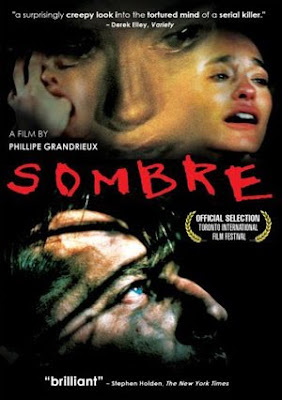
 Original Review: Beautiful and ugly film, really breathtaking at times, but just too much sadism for me, not to mention the half cocked
 I would definitely watch another Philippe Grandrieux film, because he has some impressive talent (I have no idea how he got some of these shots?), but I don't think I could ever watch this movie again(most of the time I couldn't tell what I was looking at anyway). Whenever I have watched Irreversible (which really IS brilliant) with someone who hasn't seen it I usually go to the bathroom or out for a cigarette during "the big scene", here the punishment just keeps coming in sickening repetition.
  "Bela Lugosi's Dead" was used wonderfully here, though that song would go great in any ominous scene (see the opening of "The Hunger"). This movie is basically "Henry Portrait of A Serial Killer" in a k-hole, but French so it's immaculately photographed and pretentious.
 Rewatch Review: Raised my rating a bit, because #1. though repulsed I couldn't shake this film from my head, and #2. I eventually gave in to temptation and watched it again, and though still nauseating it is genuinely striking film making at work, both disorientating and disturbing in equal measure.
  If nothing else Grandrieux like Von Treir's "Antichrist" raises the bar for horror films here, but doesn't rely on "gore" and shock the way VT did, instead generating fear from a soundtrack of guttural human cries, moans, noises, and silences, and bringing us unbearably close to characters and sensations we desperately and instinctively want to avoid.
  I still think the combination of fairy tale logic into such a brutal close focus doesn't gel as much as Grandieux believes it does, but there is something to be said for the notion that complete sentimentality and utter depravity are closer than they appear. I felt like an insect watching this movie, pinned to a wall of sounds and images. Not a good feeling, but horror films are not supposed to create good feelings are they.
  What's most horrifying about this film is it's lack of any moral aim, for all there terrors horror films do usually show the triumph of a "final girl" or the humanity of a monster, but like "The Descent" Grandrieux's universe is an unstable chaos of actions, desires, and terrors, but more so because even the logical rules of cause and effect, are no good here (like Funny Games' remote control scene but stronger and stranger), in one scene Claire and Christine escape Jean, only to have him magically appear in front of their car.
  Next cut he has them in his hotel, seemingly hypnotized as he for lack of a better word...sniffs their fear. What's so violating about a scene like this is not the violation that goes on within it, but the breaking of narrative rules that we depend on in a film like this, for respite, the chance to escape to breath. Sombre is suffocating, and makes even "love" itself, normally a redeeming force, a horror to behold.
  My first impression of Claire's attraction to Jean was echoing the Joe Jackson's "Is She Really Going Out With Him?". I felt not the usual jealously one feels when the object of your affection is publicly affectionate to the worst possible kind of person (or a decent person who is transformed into a monstrous caricature through sheer force of jealously alone), but one of panic.
  She does not know what she is getting into but we (the audience) do, having witnessed albeit elliptically at times Jeans earlier crimes. Eventually she does know who and what Jean is after he attacks her sister, but her attraction seems to intensify as our repulsion grows, and at first I felt this as a failure of understanding character development (no rational human being would willingly go back to THAT).
  But this was a failure more on my part than the films. I was expecting realism, when right from the beginning the film announces itself as not existing in a stable mental landscape of coherent naturalism. Our first images are a boy blindfolded in a field feeling his way in the air, then abruptly the sounds of children laughing like hyenas as they watch a Punch And Judy show.
 The handheld camera at times jostles around with Jean's or a detached third party pov and at others holds itself sustaining agonizing close ups, all to create it's own kind of rationality(something after watching more Guy Maddin and Mark Rappaport I find a little easier to understand or at least accept).
  Claire and Jean's relationship is non-existent guided by the films only symbolic logic(chance or reason/hope), a prop like the puppets in Punch And Judy, but where Mister Punch, would kill his wife, his family, his jailers, and in some versions even Death and The Devil himself, and do so with a smile, Jean wrestles with his demons which are indistinguishable from his desires, and suffers for them.
  The film's final shots of Jean in the woods recall Lon Chaney Jr's. performance as "The Wolfman"(1941), and all the tragedy, doom, and masculine anxiety there in. In the days of 'Dexter" where serial killers can be heroes too, were all aware that wolves can wear human skin, and men don't need to transform into monsters to make beasts of themselves.
 In Fellini's "La Strada" where a lovely clownish child-woman is hopelessly and helplessly in love with a brutish strong man who rapes, torments, and abandons her, we are forced to see "love" as a beastly thing which traps our heroin from the rational action of escape.
  But it's this break with realism and into the metaphorical which freed Fellini from the other Italian filmmakers of the day and allowed him to progress into his trademark oneiric style, and it's also what gives "La Strada" it's emotional impact, which has to be weighed symbolically not literally. "Sombre" in many ways follows suit, but with more neo-gothic, and new french extremist aesthetics.
  "Sombre" is a difficult film, one which even the most willing to attempt to understand it, will not enjoy the first, second, or maybe any times watching it. I can't say I enjoyed it. I'm not gonna put this on during rainy day like "Slim Sussie" or "Monster Squad", but if I had a friend over who told me they were in the mood for a horror movie, something actually scary (a rarity) I would suggest this. "...if my eyes don't deceive me, There's something going wrong around here..." -Joe Jackson
  Here is a much better review by Adrian Martin that gives a much clearer impression of what the film is like:


