


“Bandwagon” is the story of Charlie is a young drummer working in a record store in
 One of his co-workers has a hard rock band called “Spittle”, and noticing a female patron’s head turn as she repeats with wonder and awe, “you’re in a band?” decides to start one up for himself.
 Enigmatic Tony appears to buy some cassettes for some songs he’s been recording in his room, and the two decide to jam.
 Tony can’t play when people watch him though, so has to hide behind a wall in the garage during their sessions.
 Charlie then recruits Wynn who was kicked out of “Spittle” and prefers fishing to most everything else, and Eric a hot-head ex-convenient store clerk who has steal his bass back from a dealer he was forced to sell it to, before the band can get under way.
 The guys take to the garage complete with snide comments from Charlie’s older sister, and milk, cookies, and snacks from Charlie’s enthusiastic mom.
 Slowly but surely a sound is formed, and though there is no initial discussion of music aside from an unspoken agreement that they not be like “Spittle”, their instincts guide them towards a style.
 Their songs are simple, hooky, and melodic; a more jangly less talented version of “The Replacements”, but to Tony they are also “personal”, many including the name “Ann” somewhere in the title.
 The group dub themselves “Circus Monkey” and meet and mystical manager and legend Linus Tate, who is all but silent for the film, aside form moments when dispensing kernels of wisdom and advice to the band in their times of trail and need.
 “Anyone can get signed”, says Tate "it’s the road that the true test.”, and so the band set out to tour some of their surrounding states in a junked van that is to become their home and universe.
 I could go on describing all the twists and turns in the plot, but none of that is why I would recommend “Bandwagon”.
 Film critic Manny Farber coined the term “termite art” to describe a type of art that didn’t initially announce itself as great or amazing, but a borough like a termite into your mind, and replays itself like a catchy song, you can’t help but hum along to.
 “Bandwagon” is not cinematically very strong, it is at best capable, sometimes even a little sloppy, but it’s first time director John Shultz (who left the band he was in order to pursue a career in filmmaking) makes up for this with detailed honesty, wit, charm, and a sense of balance between naïveté and real life (even if he intentionally favors the former to the later).
 The dialog is brilliant, perfectly suited and matched to each of its characters.
 The music is something you could imagine a friends’ band playing, not too complex that it’s unbelievable, but not so staged that it’s unenjoyable.
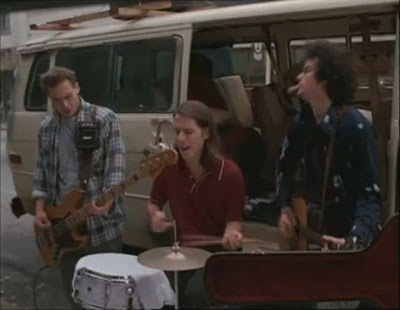 “It Couldn’t Be Ann”
(http://www.youtube.com/watch?v=EEpfFRBn3Ak)
has been laying its larval memes in my skull since I re-watched the film a few days ago.
 And as I listen I realize that though the song is decent enough, it’s the memories of the film, the characters, and what they go through that imbues the song with its character and nostalgia.
 Like “Gregory’s Girl” the film succeeds and some could argue coasts on a wave of nostalgia, but so much of film and music appreciation is nostalgia anyway, it’s hard to separate from the positive warm vibrations the film gives off.
 There have been and will be many movies about bands and musicians and the rise and the fall and the fame and corruption, and this is thankfully not like any of those.
 This is about a band that probably won’t make it, who may only be remembered by their friends, family, and a few strangers, and that’s what makes it so special.
 That’s not to say they are at peace with their obscurity either, we get the sense at the films end the band will continue, on their own terms whatever they may be, though we know John Shultz would actually go on to a less than thrilling mainstream movie career.
 In a way Shultz disappointing filmography after this also makes the film more significant, a kind of swan song, dedicated to all the feelings, dreams, and heartbreaks he left behind to step behind the camera.
 The success of the film is that Shultz makes us miss being in the band as much as he does.
 As much as Tony misses “Ann”.
 Of course, it’s not really about “Ann” it’s about the melody she inspires.
 Or as the wise Linus Tate would say “Am I here to shoot pool?
 Or am I here to clear some balls off a table?”


 What it ends up being is a video journal(shot on film) of McElwee getting hooked up (by his sister or mother who want him to marry) or trying to hook up with a variety of southern ladies, from an aspiring model to scientist living in a small island in a lake by herself.
  Watching "Sherman's March" is like discovering a great novel for the first time.
  Though it's relatively obscure, the American Library of Congress was right to include this among their important historical works.
  "Sherman's March" is complex, awkward, sad, sweet, and very funny, so rich in character and charming in it's sincerity it feels less like a movie and more like story told by a particularly vivid friend (even the stills Ive collected here look more like photos from someone's private album).
 It's every bit as personal as the achingly intimate "Crumb" and as politically complex as Micheal Moore, minus the soap box and fact meshing.
 The lines between personal, political, fiction, documentary, history, and present are blurred from the beginning, and this only continues for two hours over the course of which, McElwee's personal scars mirror the blasted landscape Sherman carved, and just as equally the South's selective memory when it come to the war.
 McElwee says "Sherman really loved the South. It must have been a terrible choice to make to destroy it.", and in doing so continues to echo a southern literary (and otherwise) tradition of ambivalence and nostalgia, concerning it's checkered past, the way many young lover's remain haunted by ex's, unsure or unwilling to admit their complicity in the demise of the thing they loved (or failed to love).
  At the time the film was made, the Cold War seemed an endless fact of history and the universe, so the threat of nuclear war looms ever in the background of McElwee's conscious.
  The world(at the time) would never be war-torn again, it simply would no longer exist.
  If there was another war there would be no time for heroism or romance, the rocket's would have eliminated everything before anyone was aware of what was going on.


