Thursday, August 19, 2010

No Exceptions, No Returns

Inception(2010)

Directed By Chis Nolan

…and the fever is going to take you again.

"Inception" is Chris Nolan taking an action film smashing it into a dozen pieces and then slowly rearranging the pieces into a typical narrative.

It could easily serve as a sequel to "Shutter Island” where Leo’s now country fried brain continues thinking up paranoid multi-level fantasies, now dressed in vague cyberpunk, instead of 50's period costume.

None of Chris Nolan’s films are particularly fulfilling in terms of character, and that is not there function nor what makes them fulfilling for viewers who do actually enjoy them, and"Inception" is no exception.

The film begins with action and in a dream within a dream, within a dream, within a dream, etc.

A team of futuristic dream thieves, who specialize in stealing information from the subconscious of sleeping victims, are offered one last big score, but this time instead of stealing information, they are going to attempt the impossible and implant a “new” idea.

If only such a team had incepted some originality into the Marker brother’s dreams, then perhaps they could Dr. Parnassus' up something bigger than cannons.

Espionage and M.C. Escher are the order of the day, as what could have been a trip into the constantly impossible world of desire and urge, becomes another sleek, neat, hotel airport of a dream world.

It’s not as ugly and wasteful as Tim Burton’s “Alice In Wonderland” but like that film the chance to explore or soak in any surreal experience are more often than not exchanged for run of the mill shoot em up and repetitive (especially for Leo on the heels of "Shutter Island") shots of looking confused and forlorn while discussing (or refusing to discuss) a dead woman.

Action sequences like the city folding in on itself, and the zero-g slanted hallway fight are thrilling and genuinely startling and truly cinematic, in ways most of this summer's blockbusters have lacked.

The actual three universe, three time stream "Inception" sequence, is brilliant at a formal level, though what it has to do with the viral nature of ideas (memetics?), or dreams I haven’t the foggiest (nor do I suspect the Nolan's).

Though it’s logic is fuzzy at best, there is some meta-fictive hyper-awareness of the literary trope of catharsis and reconciliation with the father (Luke And Darth, Neo and Col.Sander’s/Freud).

We’ve seen variations of this scene so many times, it is chosen because by the team in fact, because of it’s “primordial resonance”, but what was interesting here was seeing it played out completely serious and dramatic while still being aware of, even encouraged to root for, the completion of it’s falseness.

If The Matrix asked us to pierce the veil of Maya, than “Inception” asks us if the fake isn't sometimes better than the real thing.

But this mental tingle for all it's developed into, is akin to the feeling of gravity one experiences in their crotch on an elevator, it's a bit surprising and pleasurable, but transient and not much worth discussing aftewards.

This is not too different from "The Dark Knight’s" ending with Batman vowing to lie, or Guy Pierce preserving his ignorance in "Memento", where the lie is more important or at least more vital than the truth.

The question of whether the top is still spinning at the end, is just a red herring, the most important scene takes place in the safe.

The complex and rigid logic of how to navigate dream space, and liberalized psychodrama both serve to create just enough coherence to get us into the next big fx surprise, the gunfire is just filler, and not particularly well shot filler at that.

It’s fitting that a summer action movie about creating false desires should not only be a hit, but multi-corporate merchandising event.

But the over-determined belief that "Inception" is entertaining is backed up by the reality, though hazy at times, that "Inception" really is entertaining, even if ultimately hollow.

A classic case of summer fever, if ever there was one, where the heat waves that fry eggs on concrete, cook brain meat to batter and then to a soft gel that does'nt ask for more than digital glamour and motion.

"I think it is immoral (in the true sense of the word) to tell a story that has a conclusion. Because you cut out your audience the moment you present a solution on the screen.

Because there are no "solutions" in their lives.

I think it is more moral-and more important-to show, let's say the story of one man.

Then everyone, with his own sensibility and on the basis of his own inner development, can try to find his own solution."-Federico Fellini(1959)

Following Fellini's thoughts on realism, one could almost believe that "Inception" was a class above the likes of "Jonah Hex", The Expendables", and "Salt", that it was more than it's action sequences, and live out the communal marketing dream in uninterrupted bliss, but sadly (or happily) we do not live in the world of such delusions, and must wake up to the fact, that ambiguity is not always bravely embracing the uncertainties of life, but sometimes simply shrinking from facing them.

From the film beforehand, I have no reason to believe the end is anything more than another in a series of calculated deferrals and delays, that have less to do with fidelity to to "the story of one man", and more to the mechanics of showbizz adage-"always leave em wanting more".

If "Lost" proved anything, it's that there is a difference between asking "infinite questions", and an Easter egg search for endless red herrings, and furthermore a more crucial difference between merely asking a question, and posing a problem so that an audience generates the question themselves.

Sadly there is no moment of "Inception", in inception, and at the end I felt more like I had watched a strange pop-psychology episode of "Magician's Secret's Revealed" than entered into my (or anyone else's) unconscious.

Chris Nolan likes puzzles and he treats his films as such.

His films are solitary games he plays, almost always telling stories of men consumed with some interchangeable obsession, but I’ve yet to be truly disappointed by any of his exploits.

There are better films in the oneiric genre like Fassbinder’s “WorldOn A Wire”, or “Until The End Of The World”, even “Waking Life”, "Pontypool", “Paprika”, “The Cell”, “Dark City” and “Paperhouse” provide interesting variations on this kind of mind-game worth looking into if this film has stirred up such feelings in you.

I think “Inception” will probably hold up better over time than “Avatar”, but it’s caught somewhere between “The Matrix” and “Run Lola Run”, alternating moments of genuine inspiration and forced action clichés, and back again, but before your brain can put in them proper order the music booms out like God’s private Gong, and your pinned to your seat and who cares, the sweat pours down your head...

Wednesday, June 23, 2010

All Up In My Grill With Your Ambience

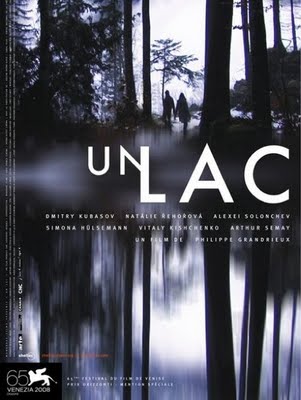
Un Lac(2008) Directed By Philippe Grandrieux

Un Lac is a tone poem of a film, told mostly in close-ups. When not getting all up in everyone's and everything's face, the camera gazes around aimlessly at fog, mountains, snow covered woods, light from the sun or moon piercing through fog, as if to alleviate the smothering, over-proximity of sheer human contact, the camera has to fuck off to the woods shake from it's head the discombobulated images of skin, hands, shoulders, and shadows. When characters are large enough to be identified as characters (and not tall shrubs) they are often at too far a distance to be individually discernable, such is "Un Lac's" prerogative, always too far or too close. If Philippe Grandrieux had a sense of humor he would make a horror film about Bigfoot, and capitalize on Mitch Hedburg's idea of the big out of focus monster roaming the woods, but sadly Mitch is dead, and Philippe is all business.
From the first few minutes forward it's apparent that the film will be opaque and ambilavant and ambigious, and like the best of ambient music and the worst of Muzak, it will at times be very boring, formless, and repetitive, but will also at times be beautiful, startling, and rhythmic. How much you like this film will really amount not to Grandrieux's talents (which are not without merit), but your appreciation for this style of art.
If you have a great sense of patience and sensitivity for minimalism, than Grandrieux's shaky cameras and general blurry fuzziness, work together to create a cinematic white noise drifting over a skeletal framework of tension and actions. If not it's going to be annoying."Un Lac" is not quite completely abstract non-narrative experimental film making, but it's a vicious flirt with being one, and teases our hopes up numerous times that it will eventually unmoore itself and let Grandrieux's visual style finally run naked and free. Alas, he remains shackled to a plot consisting of some really cheesy and rather typical French movie incest bullshit at a rural lake house/logging cabin, between a doe eyed sister and her dark eye socketed (we get it your supposed to be creepy) brother. At least until some hot guy shows up to work the timbre (no pun intended) and then the brother get's jealous, and the girl falls for the guy, and the reason I didn't fall asleep altogether before the end was because of the overdetermined suspense (from my previous experience with Sombre), that the brother was going to murder his rival with an axe on some Dostoevsky shit. This sadly never happened.
At times watching the faces and shapes emerge from Grandrieux's primordial darkness of dimly lit shots has a rugged elegance. Instead of vibrating with terror, fear, or as much disconcerting menace as it did in "Sombre" the camera has now learned to tremble. It may be trembling because it's filming on a snow covered lake and it's dark and it's cold, or it may be because he or she (you know the one) is looking at you from a distance. We almost never get a full frame so determining what exactly is happening in any given scene is a chore, one occasionally rewarding, but mostly tedious. Totality is anathema in Grandrieux-land, so seeking closure or completeness visual or otherwise is a fools errand here. At one point early on (though the place in the film's chronology are debatable since it's all pretty non-linear) a character has a seizure, and lays twitching in the snow. I believe this causes other characters to later search for him in the woods when he doesn't return home. Both yield material for interesting visual scenes (ultra-earthquake shakiness in the former and flashlights in the darkness later) but are irrelevant to the love-triangle that's going off and on in the films center, flickering like a dull lightbulb. The entire film is like this, which is not the worst thing in the world if your an imaginative person, attuned to the Zen pacing. One should remember "The Simpsons", and Homer's once initial failed cult initiation, and response to the question, "What? None of what you mentioned was in the film. Did you even watch it?", "Oh yeah, well when I get bored I make up my own movie.", because it's precisely what everyone does who comes to a piece of minimalism like this. The film is in perpetual limbo, and it's the viewer who will trek through it to find their own heaven or hell. Though where Tsai Min Liang's glacial minimalism in "What Time Is It There?" developed and played with our ennui, emotions, and assumptions in ways which were ultimately both edifying and tragic, Grandrieux is sadly satisfied with willful obscurance. For it's niche it's an interesting mood piece, but it's so ephemeral that unless you can as Homer did, project yourself another imaginary film or mental space on top of this one, there isn't really enough material here to make this movie any more than what doesn't meet the eye. Squint and look out of the corner of one of your eyes, and you have a pretty clear idea of "Un Lac's" style. This is also the type of image the film is most likely to linger on; a close up of an eye either darting around like mad or phlegmatically staring at it's own lashes. Is the nearness of the camera to all it's objects, a representation for the characters isolation from the world outside of their family, outside of the lake, intentionally trying to make their limited perspective into ours? If so one would expect the final scene of the sister for the first time, on the lake and not the shore, to be fuller, wider, more...well anything. Instead her flight does not change anything, (and this may just be me projecting) but I remember almost a look of disappointment or confusion on her face in that scene, that their wouldn't suddenly be more once she got onto the lake. I scowled in sympathy.
I understood why she should be confused, there is never any true "escape" from our troubles, the world does not expand when we go to a new place, the narrow camera of our eyes is just turned to a new set of familiar objects, to covet, attain, and regret, and even that all depends on how well we can tell the parts from the whole. As you can see I have projected a good deal into and onto this, so I can't completely dismiss the movie and it's brand of experiential cinema.
It is not wrong to want more from minimalism, when it's nature is to create this desire for form and awareness of absence. However it is wrong to not care at the end of a film. And at the end of "Un Lac" I didn't care about what I had seen. So if you think you will like it, you probably will, and if you are suspicious go with your gut. Squint and look out of the corner of your eye again.