
 Directed By Hal Hartley
 “Surviving Desire” is an early effort from American independent filmmaker Hal Hatrley who was and is one of the best kept secrets of the 90’s.
  This film which oozes with Gen X style, is the story of an eccentric college professor, played by Hartley muse Martin Donovon, who has spent several weeks going over the same paragraph from a Dostoevsky novel, much to the chagrin and outrage of his literature class.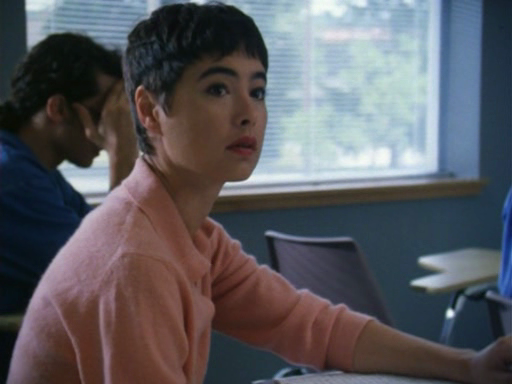
The students call the professor a crank, fraud, a pretentious buffoon etc, but he remains trance-like and unmoved in his obsession to get down to what those few old Russian words really mean.  One of his students, who is the classic short haired impish beauty you might find a Godard movie, named Sophia (“Greek for wisdom” a friend tells Donovan), an aspiring writer herself, finds Donovan more sweet and naïve than worldly and authoritative (as he seems to imagine himself.)
 The professor feels the attraction sucking his life in, before the two exchange words outside of the classroom.
  The pull of attraction between the two is more a riptide they are pulled away in than an act of will from either parties.
Donovan debates the merits of love, lust, communication, and desire with a colleage who at the beginning of the film we are informed was fired from his position at the university.  The friend is emotionally unscathed picking up at the campus bookstore the next day, and a series of odd jobs as the film goes on, each a little odder than the next.
  Donovan’s freinds nonchalance at life, is opposite his own obsession with a single paragraph and a single young Sophia.
The film is just under an hour and the short run time serves the thin story well, never inflating itself with pointless sub-plots or meaningless scenes.  The thrifty editing which divides the film up into neat vignettes is one of Hartley stronger gifts, and it is closely linked to his sense of deadpan humor and comic timing.
  One has to work on a campus bookstore to truly appreciate Sophia’s aimless “Does anybody need any help?”, lines which become bittersweet by the film’s end.
 For the three Hartley films I’ve seen so far “Trust”, “The Book Of Life” and this, the ironic deadpan which coats the performers in Robert Bresson stillness, is an armor his characters generate to hide the embarrassingly simple (or so they seem to imagine it) wants and desires of being loved, and being truthful (even if it’s just to “thine own self”).
Musically Hartley sticks to his trademark alternative guitar snarls as punctuation (music he was at this point in his career writing and performing himself), but here he also branches out into a unexpected and contradictory as it sounds a silent-musical number that recalls fellow neglected American indie auteur Mark Rappaport (weirdly you feel as if you can almost hear what the characters are dancing too). “Surviving Desire” has an understated wit, intelligence, punky defiance, and collegiate malaise that is part and parcel of smart hip indie flicks, but also is not above indulging in the slapstick and fast talk of American comedy classics.
  The film has a heart, a brain, courage, and a sense of personality though in many ways it uses most of the same techniques as “Trust” they are all working in perfect balance and symmetry.
  Homeless woman who propose marriage to passerby’s and bands who serenade their loves in the middle of the street pepper Hartley’s landscape with a lovelorn delirium, that keeps the film from taking itself to seriously, when melodrama threatens to consume it.
Though this is less accessible than “Trust” arguable Hartley’s finest feature, the metaphorical nature of the professor seeking the young girl, and the professor seeking wisdom, and deciding to try to win them both, all the while knowing they can only be transient.  "Surviving Desire" is about as good a combo of date movie and philosophical allegory as you’re likely to find from any other directors mentioned above (though Charlie Kaufman seems to have inherited this torch).
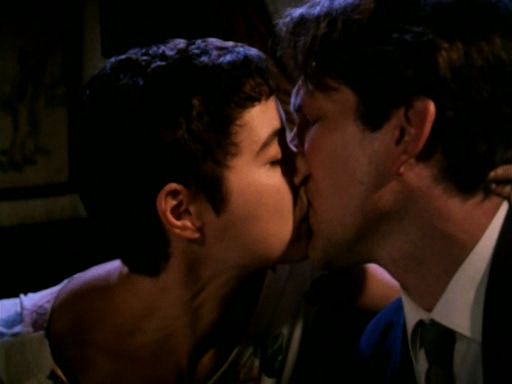 The final words on the chalk board, sum up the films themes that play on the meaning of the name Sophia, and stand as romantic opposition to Ingmar Bergman’s existential musings in “The Seventh Seal’s” when Antonius Block says that “Faith is not enough. I want knowledge.”
By the end of the film I was feeling as romantic about the Faustian search for knowledge as I was melancholy about Sisyphus like world of modern dating, which is to say I liked the film because I identified with it.  Another line from “The Seventh Seal” , which seems more appropriate after one has watched or is literally “Surviving Desire” in their own lives, “Love is the blackest plague, but you don’t even die of it and usually it passes”.
  That is also exactly the kind of line Martin Donovan would be likely to say after sipping a coffee or taking a drag of a cigarette; expressionless as a corpse.


 Yes, that is one of the things this movie is certainly about, but there is much, much, more.
  The magicians have a female assistant, and she is having an affair with one of the brothers, who believes her to be in possession of the object.
 I’m a bit foggy as to whether or not she really did have the artifact.
  Certainly an item did appear on screen, but as to whose it was or whether it was authentic, I can’t recall, probably because it wasn’t the point.
  The artifact is a mcGuffin, serving to bring our characters together, and is all but forgotten about by the end.
 The magicians assistant begins having an affair with a wealthy eccentric she meets one night after a show, partly out of impulse and partly because she has nowhere else to live.
  The wealthy man enjoys photographing all of the women he romances with their faces a few inches away from each other, “as if we were just about kiss”.
  The magician’s other brother falls in lust with the wealthy man dating the assistant.
  The assistant also had a relationship with a woman involved in performance art, as well as a band called “I’ve Got My Shit Together”, which involves the title being repeated an the chorus in a Joan Jett kind of way.
  At one point all of these characters end up at a large house together, and there is a kind of Mexican stand-off of awkward and amorous glances, similar to Claire Denis’ “35 Rhums” bar-room scene (that film’s finest moment).
 There is less voice-over narration than in Rappaport’s previous “The Scenic Route”, and one continual character’s feelings and emotions to focus on might have improved some of the film’s unfocused feeling.
  The Scenic Route was full of asides and musings, but it was a controlled sprawl, where Imposter’s sometimes feels more like a sketch or a scrawl.
  Love, betrayal, honesty, and notions of identity (and this time around sexuality), are again the central themes and plot devices which move the characters in between Rappaport’s painted backgrounds and nuanced art decorum.
  The murderous twin’s bicker back and forth to each other like a vaudeville act, one of them clearly the flaming witty gay (and more sociopathic) of the pair, while the straight one is also the duo's straight man, preferring to only kill out of necessity, and more emotional over his latest target than he should be.
  He once nearly married a princess, til his partner killed her, claiming she was set to turn them in.
 The brother’s bickering and care free crime spree, is the dark comic skeleton of the film, while the story of the wealthy eccentric and the assistant is the films emotional heart.
  The assistant does seem to become genuinely happy or at least resigned to happiness with the man, but he is perpetually jealous of others he belives her to be involved with, both correctly and incorrectly.
 The accuracy of his claims however, is as immaterial as whether or not the Egyptian artifact is priceless or a trinket, his fears of abandonment, like the brother’s murderous swath of new and assumed identity’s, is pathological.
  Both groups of men can seem only capable of wanting what they can’t have, and when they can have it, must destroy it to again make it unattainable.
  The assistant is uncertain at times, as to what she really wants, going back and forth between them all, but she certainly doesnt want to alienate or destroy them.
  She resolves to a decision that makes allot of sense in this context, and all of the stories play out with little surprise, but Rappaport films make their surprises a part of their sets, dialog, editing, art and costume design, and only mildly as part of their plots.
  If you haven’t seen any Mark Rappaport “The Scenic Route” is to my feeble knowledge, the best place to start, but “Imposters” is a great follow-up to Rappaport’s filmography which continues, try as I might, to defy description.


