
Loong Boonme Raleuk Chat(Uncle Boonme Who Can Recall His Past Lives)(2010)

Directed By Apichatpong Weerasethakul


This years Palme d'Or winner at the Cannes Film Festival, "Uncle Boonme Who Can Recall His Past Lives" is the story of a man who is dying, and as result recalls his past lives and is visited by ghosts and spirits.

There are ape spirit creatures who lives in the forest attracted by his sickness, he remembers being an ox and a princess, we watch a nurse drain some device the ailing Boonme wears fixed to his abdomen.

This was the first film I watched at 2010's AFI Film Festival in Los Angeles, and it was a start that was not followed easily. The film is strange but the words which feel most appropriate to the film are "gentle" and "mysterious".
 Boonme's final days are spent with his sister and a nurse and their various supernatural guests. They eat dinner, watch films, look at photo albums, life unfolds but with an awareness of a mysterious shift coming.
  As death approaches, past lives and those human, animal, or other appear ever-shifting and inter connected, foreign but also familiar, like relatives returned after a long absence.
 "Uncle Boonme" is the final part of a multi-platform project featuring art installations and short films called "The Primitive Installation", about Nabua, Thailand a region heavily occupied by the Thai army from the 60's to the 80's.
  "Uncle Boonme" believes his karma is the result of the part he played in the violence of the past.
 Director Apichatpong Weerasethakul ("Joe" for short) has created a landscape of shadowy jungles, intimate bedroom lighting, a haunting, funny, dreamy, and wise, rhythmic lamentation about modern life, it's "primitive" counter points, death, change, spirit-monkeys and all that good stuff.
  Uncle Boonme is a fantasy as epic as Souleymane Cisse's "Yeelen", one luminous to look at and visually wander through, with several of "Tropical Malady's"' most hallucinatory moments, appearing strong early in it's opening movements and closing out on notes as elliptical as those of "Syndromes And A Century", and then there's the final scene compressed into a wonderful kind of epilogue involving a monk, that's the most audacious, fascinating, and best of it's sort since Wes Anderson's "Hotel Chevalier"."
 Transformations and contrasts between the ancient and the modern flow into one another from electronic bug zappers to sex with talking cat-fish, primordial caves to karaoke bars.
 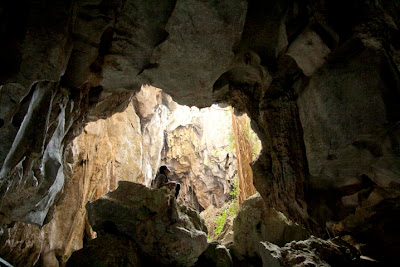 Dual and multiple-roles and states within a single whole, are a recurring theme in the film, so multiple meanings and readings being generated is little surprise. But though these thoughts rise up haunting us after viewing, the images of movement through Nabua's phantom jungles and Boonme's warm goodbyes are what we are left feeling and reeling with.
 All modern worlds are built on ancient ones, all new things have within them older forms. "Uncle Boonme" is more informed by Buddhist notions of reincarnation, the idiosyncratic personality of it's creator and the psycho-geography of it's location, more than normal concerns about dramatic and character arc.
  In simpler words...an old man who is dying can recall his past lives. The film is a matter of perception as complex and post-modernist/globalized as any experimental narrative in avant-garde-dom or as mystical and "primitive" as any ancient Sutra, based on the cultural inclinations and presuppositions you bring to the film.
  In any event, is to Joe's continued success and cinemas continued fortune that he so playfully and beautifully can challenge and delight these hybrid perceptions of ours as he does.

 Directed By Apichatpong Weerasethakul
 In "Syndromes And A Century", a love story is repeated twice, once in a rural hospital and then again in a modern urban state of the art hospital.
 The first time it's a direct and unrequited affair involving a janitor in love with a female doctor, the second time around it's two doctors in a fading formal romance where now it's the female who seems to be rebuffed by her male partner.
 In the first scenario a monk and a dentist discuss their life's passions, the monk for modern music (he always wanted to be a
  While in the second scenario's at the high-tech facility where the dentist is attended by staff, the doctor and the patient don't talk at all accept for the patient trying to remove a face cloth (which would blot out his person hood altogether for the dr., as if he were fixing a car).
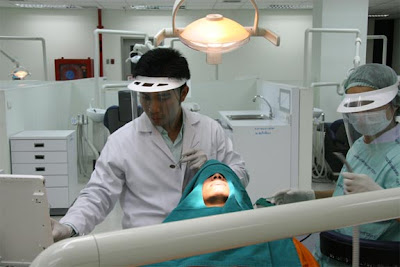 So in this instance it would seem the film mourns the loss of communication; the old humanity suffering the new sterility, or as the Modest Mouse song goes "Party of the century/parting of the sensory".
 Yet in another scene, a senior doctor and head of the modern hospital has a happy hour of drinks with colleagues, before she goes on tv to do a public health lecture/interview.
 When a patient appears she tries an alternative medicine laying-of-hands cure, where a doctor at the more rural hospital earlier politely dismissed, the "ancient" remedies offered to her by a monk.
 Ive watched a few of Apitchatpong's ("Joe" to fans who stumble while pronouncing his name) amazing short films since seeing his earlier masterpiece "Tropical Malady".
 In 1998 he made a film called "Thirdworld", an experimental documentary about an island community.
 One imdb description aptly summarizes, "The title is intended as a parody of the word that is being used by the West to describe Thailand or other exotic landscapes...The film is presented in crude and rugged quality, as it is a product from the uncivilized...".
 I think this line of thinking extends to Syndromes.
 True, the first half grew from the story of how his mother and father met each other once upon a time at a rural hospital, but the second half, expands the story from the personal (and very endearing), to the political/cosmic (there are many shots of statues of Buddha, in both hospitals, as a sly nod to reincarnation).
 Unrequited love and the relationships between healers and patients, remain regardless of time and place.
 Life goes on, as they say. People are determined by their environments, but not always in easily predictable ways; monks can be
  The scenes of hospital drinking and a monk using a remote control flying saucer, caused the film to be censored by the Thai government, as apparently this would, "Undermine or disrupt social order and moral decency, or...might impact national security or the pride of the nation".
  Tropical Malady's gay tiger shaman were acceptable, but monk's using electronics...blasphemy.
 A Thai official said the Thia people were "uneducated and not intellectual", and so needed big gov to tell them what to not watch, which seems very similar to the ideas that informed "ThirdWorld"; unwashed masses in rural areas are backwards peasants, who need the "modern world" to intercede on their behalf as an adult would to a child.
 "Syndromes And A Century" adds a complex dimension of inter-connectivity, allegory, and muted elusive imagery (like the several minutes of close up on a funnel sucking in gas) to the dichotomy of rural/urban, ancient/modern, growing romance/fleeting emotions, etc.
 Of course what makes this movie excellent is the demure photography that takes us from the lush silent forests to concrete parks where groups of citizen's gather to exercise to what sounds like video-game techno-pop.
  Or in other words, and words straight from the horses mouth at that, Joe says, "[the film is about]how we remember, how our sense of happiness can be triggered by seemingly insignificant things.
 Time is collapsed to mimic a pattern of remembering and to manifest my belief in the idea of reincarnation.
 This is the third film in which I've used the structure to explore dualities, and I think it will be the last.
 The word 'Syndromes' could apply equally to Blissfully Yours or Tropical Malady : it does refer to human behavior, such as the way we fall in love.
 I don't intend the word to have negative connotations; if falling in love is a kind of sickness, it's one for which we all show symptoms.
 'Century' for me conveys the sense of moving forward.
 A century is more or less the same as a lifetime.
 I'm interested in the ways things change over time, and in the ways they don't change.
 It seems to me that human affairs remain fairly constant."
 "Syndromes And A Century" is a pretty, moody, dryly humorous, and multi layered, without feeling forced (if a little incomplete though).
 In any event, or possibly reincarnation of events, movies like this give me hope for the future of movies.


