
Imposters(1980)
Directed By Mark Rappaport
Mark Rappaport’s "Imposters" is about two magicians who claim to be twin brothers plotting to steal an ancient Egyptian artifact, while sporting matching male pattern baldness, mustaches, and outfits of all sorts.
 Yes, that is one of the things this movie is certainly about, but there is much, much, more.
 The magicians have a female assistant, and she is having an affair with one of the brothers, who believes her to be in possession of the object.
 I’m a bit foggy as to whether or not she really did have the artifact.
 Certainly an item did appear on screen, but as to whose it was or whether it was authentic, I can’t recall, probably because it wasn’t the point.
 The artifact is a mcGuffin, serving to bring our characters together, and is all but forgotten about by the end.
 The magicians assistant begins having an affair with a wealthy eccentric she meets one night after a show, partly out of impulse and partly because she has nowhere else to live.
 The wealthy man enjoys photographing all of the women he romances with their faces a few inches away from each other, “as if we were just about kiss”.
 The magician’s other brother falls in lust with the wealthy man dating the assistant.
 The assistant also had a relationship with a woman involved in performance art, as well as a band called “I’ve Got My Shit Together”, which involves the title being repeated an the chorus in a Joan Jett kind of way.
 At one point all of these characters end up at a large house together, and there is a kind of Mexican stand-off of awkward and amorous glances, similar to Claire Denis’ “35 Rhums” bar-room scene (that film’s finest moment).
 There is less voice-over narration than in Rappaport’s previous “The Scenic Route”, and one continual character’s feelings and emotions to focus on might have improved some of the film’s unfocused feeling.
 The Scenic Route was full of asides and musings, but it was a controlled sprawl, where Imposter’s sometimes feels more like a sketch or a scrawl.
 Love, betrayal, honesty, and notions of identity (and this time around sexuality), are again the central themes and plot devices which move the characters in between Rappaport’s painted backgrounds and nuanced art decorum.
 The murderous twin’s bicker back and forth to each other like a vaudeville act, one of them clearly the flaming witty gay (and more sociopathic) of the pair, while the straight one is also the duo's straight man, preferring to only kill out of necessity, and more emotional over his latest target than he should be.
 He once nearly married a princess, til his partner killed her, claiming she was set to turn them in.
 The brother’s bickering and care free crime spree, is the dark comic skeleton of the film, while the story of the wealthy eccentric and the assistant is the films emotional heart.
 The assistant does seem to become genuinely happy or at least resigned to happiness with the man, but he is perpetually jealous of others he belives her to be involved with, both correctly and incorrectly.
 The accuracy of his claims however, is as immaterial as whether or not the Egyptian artifact is priceless or a trinket, his fears of abandonment, like the brother’s murderous swath of new and assumed identity’s, is pathological.
 Both groups of men can seem only capable of wanting what they can’t have, and when they can have it, must destroy it to again make it unattainable.
 The assistant is uncertain at times, as to what she really wants, going back and forth between them all, but she certainly doesnt want to alienate or destroy them.
 She resolves to a decision that makes allot of sense in this context, and all of the stories play out with little surprise, but Rappaport films make their surprises a part of their sets, dialog, editing, art and costume design, and only mildly as part of their plots.
 If you haven’t seen any Mark Rappaport “The Scenic Route” is to my feeble knowledge, the best place to start, but “Imposters” is a great follow-up to Rappaport’s filmography which continues, try as I might, to defy description.


 Directed By Mark Rappaport
 "The Scenic Route" by Mark Rappaport is a forgotten American masterpiece.
 There are no other movies like this as far as I know, but up until a few weeks ago I had never heard of this, so it’s possible there could be hundreds of films like this.
 Movies like this leave you uncertain as to the possible parameters of cinema. I have become unmoored.
 There are no IMDB reviews of the movie, and the one review Google did lead me to (after I finished writing this I found Roger Ebert's very enthusiastic review:
 Having seen the film twice now I have no idea what that means. Other reviews that mention humanity turning into empty “cultural antennas” seem equally abstract and unhelpful, but I can understand a temptation present in both, to throw up your hands and just give up on descriptions altogether. I am resisting this temptation, maybe against my better judgment, but this movie deserves discussion.
 To the best of my understanding “The Scenic Route” is about two sisters who end up dating the same men, and deal with the emotional fallout of all of the unspoken but not un-manifested jealously and problems of identity that this comes to imply.
 Does he love me, or is he using her to get back at me?
 Is she using him to get back at me?
 Does she resent me for stealing him?
 Does he want us both?
 Is this apartment his private harem?
 Was I using her to sabotage a good thing with him?
 Will any of this make me happy? Am I already happy?
 Thoughts ebb and flow like this, each sister getting a portion of the films very heavy voice over narration, which covers the mundane, to the poetic, the amusing, and completely lifelike.
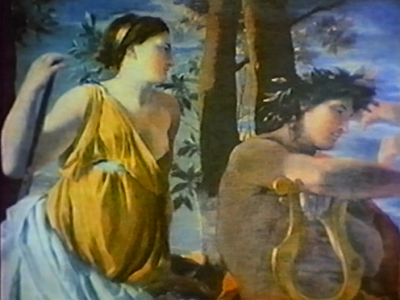
 The twin streams of thoughts occasionally collide, when both sisters love the same painting of a woman lying on a bed made of the ocean as a man leers over her watching her sleep.
 It’s a central image in the film, appearing in dreams where each sister imagines herself the woman, and as the very real painting one hangs on her wall and another claims she used to keep on her mantle.
 Visually the film is built out of tableaus where the wall paper on an apartment building is as liable to change as the clothing the characters may be wearing or their positions (standing, sitting, leaning) all during the same conversation without mention.
 “The Scenic Route” begins with one sister leaving her boyfriend claiming she wants to see “the heroic and mythic landscapes of America” and then setting down a series of post-cards, never actually traveling anywhere.
 When the plot seems to be settling down into one predictable mode, an interruptive element is introduced in Bunuelian fashion, such as the mention of a “shot-gun” murder on the loose, a coordinated dance sequence to “Dr. Love”, or travel illustrated by the walls slowly raising up and revealing the characters to be actually in a field(not to mention the hilarious incident of the man on the street whose eyes run away with him).
 Though perfectly dead pan that last bit is actually more fitting a jab at American life than it might realize, where travel is not the “heroic” road movie we’ve come to expect, but walls which replace each other with other walls.
 The layers of artifice laid over one another, like the internal monologues laid over the superficial melodrama is perhaps why some view this film as a cultural indictment of consumerism or whatever, but I think this may be reaching for some cultural credential that can easily make coherent what isn’t necessarily made to be.
 Not that the film is meaningless by any means, on the contrary it resounds with feelings of resentment, desire, jealously, and wonderment, but that doesn’t mean it has to be important to anyone else but the characters.
 What’s great about “The Scenic Route” is that it’s a simple story told as if it was the only film ever made. Imagine a friend telling you about an awkward evening but in the style of grand opera and full of poetic asides.
 The sisters really only date two of the same men, and the first one doesn’t last long, since he knowingly ricocheted from one bed to another, but the second who was dumped for no particular reason earlier returns innocently into the awkward triangle which compromises the remainder of the film.
 He does not get any of the voice over narration however.
 In Rappaport's world it’s ladie's night every night and men do seem interchangeable like consumer goods, but if you ask two siblings to share the same toy they are bound to use it as a battleground for their personal grievances.
 For instance, one sister murdered the other’s boyfriend and was placed in an asylum for years, being released from the institution as one escapes her unhealthy marriage. I was even considering the possibility that they were the same person, the crazy sister representing the divorcee’s repressed desires (the crazy one sleeps with more men, is less neurotic, etc).
 You will notice I haven’t referred to them by name, and that’s not because they don’t have names, but because there is dreaminess about the film which makes such labels mute. Orpheus is evoked as a myth, the divorced sister would like to live by, and it’s unclear if she does, at moments she is, but then again she isn’t, but the moments when she may note a similarity make the analogy worth while, and give her life and extra sense of meaning where perhaps there is only soap opera silliness.
 Vincent Cabny who published that unfavorable review back in 1978 also added “There's nothing really wrong with them if you're willing to supply your own critical system that justifies the film maker's dead-panned pursuit of the banal.”
 Indeed, I have worked up such a system, but why is this wrong? What is life but working up a system to justify the banal?
 This is precisely what the characters do connecting the divorcee comparing her life to Orpheus and expecting an epic, and the crazy expecting normality she can have a life just like her “normal” sister, right down to snagging up her normal boyfriends (whether they really are normal or not).
 Whatever can be done to make life less life-like is to be done, whatever paths that can be taken to distract us from the horrors of travel shall de driven down.
 “The Scenic Route” is about absorbing the distractions, the intangible internal sensations, and the fleeting glimpses into the absurd and the dull all around us.

 All I know is I had a goofy as smile on my face for an hour and a half and it never threatened to abandon me once (bare in mind I’m a big fan of Vera Chytilova’s similarly disjointed and lost to the ages comic fantasy “Daisies”).

 When you are busily searching the information super-highway absorbing all that is new and “modern” with movies, or art, or music for “newness” sake and the novelty wears thin and you begin to lose faith and lose heart “The Scenic Route” may restore your faith in cinema, it showcases the irrepressible eccentricity at the heart of all great movies, if only we would take the time to look.


