The next time someone tells you that movies today are more violent, nihilistic, coldly stylistic, or theatrical than they used to be or alludes to some golden age of
"humane" films, you can spit in their face for
L'Inferno.

This 1911 silent film were it to be made today would be decried as offensive, disturbing, gorey, inaccessible, miserablist, and sensationalized, which are all valid criticisms that would be rendered meaningless after watching the exquisite images for only a few moments.

If cartoons depicting
Islam can get fatwa's declared on their artists, what would the response be to a film which depicts the prophet
Mohammad with his intestines hanging out in the special hell for those
"heathens" who lead people away from the faith? Nothing this disturbing could be made today, imagine it for a moment with modern effects and you understand why.

The film follows poet
Dante (inspired by the death of his beloved Beatrice) and his guide
Virgil through the abyss and several of
Hell's rings passing such landmarks as the
River Styx and the forest of trees that gush blood because they are souls who've committed suicide and are sentenced to grow from the earth forever bleeding and bound in place.

The film occasionally gives us a flashback to how a specific sinner that Dante or Virgil might recognize from their own lives or the history books, wound up in their particular spot; like the man found buried up to his waist eating the severed head of the man who locked his family in a dungeon where he was forced to watch them starve to death before killing himself by bashing his skull into a wall.

Because of artistic and technological reasons these acts are not depicted in ways we would today call graphic, but considering this was the first Italian film ever made, the violence must have been a thousand times more shocking than today, and today it's still pretty unrelentingly bleak.
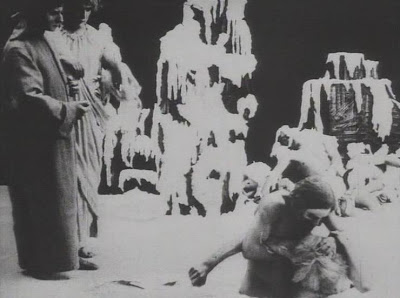
The set designs are really what drive the film, using
Gustave Dore's (one of my favorite artists) illustrations of the Inferno, as story boards and drawing from them with the same attention to visual detail that
Zach Snyder gave to his
Watchmen and
300 adaptations, but since Dore's work is better than either of those the effects are dazzling.

Giant devils swallowing sinners whole, floating and flying swarms of angels, and landscapes littered with naked bodies writhing on the landscape like a carpet like of limbs (
which are identical to some seen in Lars Von Trier recent Anti-Christ) help materialize Dore's hell, in vivid detail of a painting come to life.

Personally I have trouble connecting emotionally with silent films, mostly because of the lack of music and sound in general, a central element I respond to in movies.

Good music can make a mediocre film great, and whats more challenging about silent films is that they often come with what seem like arbitrary classical scores, or in the case of this film, a terrible soundtrack by
Tangerine Dream.

Though I appreciate
Tangerine Dream's efforts to capture something of the film in their score, I can't imagine anyone actually wanting to use very much of their music.

Not wanting to listen to
TD and not wanting to listen to actual
"silence", I decided to choose my own soundtrack, and chose the music I had most recently put on my computer, Seattle experimental band
Xiu Xiu (named after a Chinese film they deemed "the saddest movie ever made").
I chose my favorite songs of theirs and ordered them at random, and bizarrely the songs synced up perfectly.

I really mean perfectly, like when the word "angel" would be sang, an angel would appear, when
"kill yourself" was whispered, a character would be killing themselves on screen, not to mention numerous instances of the music cueing to the action, in divine serendipity.

I felt as the first hippie must have felt when they decided to listen to
Dark Side Of The Moon while watching
Wizard Of Oz. I hadn't thought about it beforehand, but Xiu Xiu's songs which are almost always about characters wallowing in despair, disappointment, sexual and emotional abuse, or self loathing, was a perfect compliment to a film about traversing a netherworld where everyone is recounting their own tortured and obscene personal tales.
 Xiu Xiu's
 music which fuses goth pop, industrial, Asian percussion and Gamelan music, folk and prolonged silences made eerie and haunting the sorrowful black and white images that
Tangerine Dream steamrolls over in each scene of soupy synths and classical muzak.

I'm taking an editing class at the moment, and since I'm pretty sure the film is out of copyright (
it can be found online here: http://video.tiscali.it/canali/truveo/3172502461.html), I'm considering putting the soundtrack over the film itself and making a copy or two for some friends, provided I get my work done quickly this semester.

The soundtrack worked out so well, I would feel completely confident in showing it to anyone who would listen.

Of course if you don't have access to this music, don't want to wait for my copy, or just don't like the band in particular, add a soundtrack of your own, preferably something dark and ominous.

I'll be doing more of these silent film mash-ups in the future, and I recommend everyone to experiment and try the same and let's see what works and what doesn't. The lack of soundtrack is an opportunity to re-create these films for ourselves, and since this first experiment was such a success I'm really looking forward to all the future possibilities.

Whatever sounds you use or don't,
L'inferno is a visually audacious and marvelous adaptation of a great literary classic.

A "
challenging" work to say the least, I first tried to read to impress a girl I liked (
who loved the book), and never finished, but a tale worthy of being told.

In 1989 director
Raul Ruiz and
Peter Greenaway made the first 2 parts in what was to be a four part miniseries of the entire Inferno (
other directors who were to complete the series were Terry Gilliam, Zbig Ribzynski, and Nagisa Oshima, but unfortunately the money ran out for the project just before Gilliam's turn; the Gilliam curse in action!). 
There was also a 2007 animated version done with paper cut outs, using modern celebrities and historical figures as its sinners that Ive seen some of and also never finished.

I haven't seen many silent films, but this is definitely one of the most striking, and it belongs amongst the great early works of fantasy like
Fritz Lang's "Metropolis", "Nosferatu" and a
"A Trip To The Moon". Gustave Dore, The Divine Comedy, and
Xiu Xiu are a nightmarish trinity of epic proportions, and combine to create a truly classic film which deserves to be seen.
 "Abandon all hope ye who enter here.

 Directed By Buster Keaton
 The perfect remedy for lousy depressing “art” films and disappointing “kick-ass” Hollywood films is Buster Keaton.
  At least it was for me on a dark and raining night last week, when I decided to watch one of his movies.
  “Sherlock Jr.” which I was told by trustworthy authorities, was his best film, and though I haven’t seen the rest to verify, it’s become one of my favorites, and if nothing else it is at least Sherlock Holmes done right.
  Buster is a young projectionist at a movie theater with dreams of being a detective.
 He is in love with the theater owner’s daughter, but is sabotaged by another would be suitor.
 Despondent he falls asleep on the job and has an elaborate dream sequence which lasts for nearly half the film where he imagines himself to be Sherlock Holmes.
  This is after a brilliant, beautiful, and amazing sequence when Keaton enters and exits the movie screen dancing nimbly in and out the frame, during a montage that shows where Woody Allen’s “Purple Rose Of Cairo” took it’s inspiration.
  The sequences as Sherlock involve a game of pool with an explosive ball on the table, and a chase sequence on a bike being driven by no one (the score to the version I watched alluded at points to the James Bond theme).
  I almost felt bad for judging the modern Sherlock Holmes so harshly for it’s bromantic action style.
  I use the word “almost” because the action sequences in Sherlock Jr. are infinitely more inventive, realistic (as in real stunt men, not CGI), and fun than anything in Ritchie’s movie.
  I was a bit weary at first, the set up sequence with the stolen wallet being a preamble not nearly as entertaining as the dream sequence to follow.
  But that’s a minor complaint in a lovely film. I watched another Keaton film back to back with this “One Week” which I enjoyed even more.
  To use modern terminology this film would be described as “post-modern slapstick”, but like Jorge Luis Borges, Keaton was far ahead of his time before such words were invented.
  Keaton’s glances at the screen for how to approach the woman he loves, is a sweet ode to cinema’s powers to connect to real human feelings and desires, for good.
 Micheal Haneke could learn allot here.
 He seems (but I could be wrong and feel free to correct me) sui generis in his preceding Charlie Chaplin and being perhaps one of the first American filmmakers to bring vaudevillian physical comedy to the cinema.
 But I could be wrong, and I’m happy to be schooled and discover more.
 Also did I imagine the sexual joke at the last scene was Keaton shrugs his shoulders?
  Oh Buster :)...

 Directed By Carl Theyodor Dreyer
 The only silent film, Ive ever had a real emotional reaction to.
 All of the characters besides Joan look like ancient statues, while she alone appears to be the only real feeling human in the film.

 Even without a story attached (there is one), I imagine this film would be clear to anyone; the old men, the young girl, the judgement, the fire, but really the story takes place across Joan's face.
  Anyone raised in an evangelical environment might recognize the look of awe and terror in Joan's eyes, as she speaks from some distant barely submerged place of conviction and we get the sense, that she not only speaks but thinks in never ceasing prayer (the rest of you can rent "Jesus Camp", for a better sampling).
  What's particularly amazing about this film is that God, is not represented by any kind of surreal or Biblical image, the notion of "faith" is made flesh in Joan, it's "long-suffering" maximized in every close up.
 What makes this film so appealing I think to both the religious and secular crowds, is that it is a human film first and foremost, but it's also open to and geared toward a religious reading.

 But that's all just talk (which this film has little of), the story is in the images, and this is one of the few examples of a book which may be best judged by it's cover, because that picture of Maria Falconetti (who never made another film after this) is the image which everything here revolves around.
 Directed By Francesco Bertolini, Adolfo Padovan, and Giuseppe de Liguoro
 Alternate Soundtrack by Xiu Xiu


